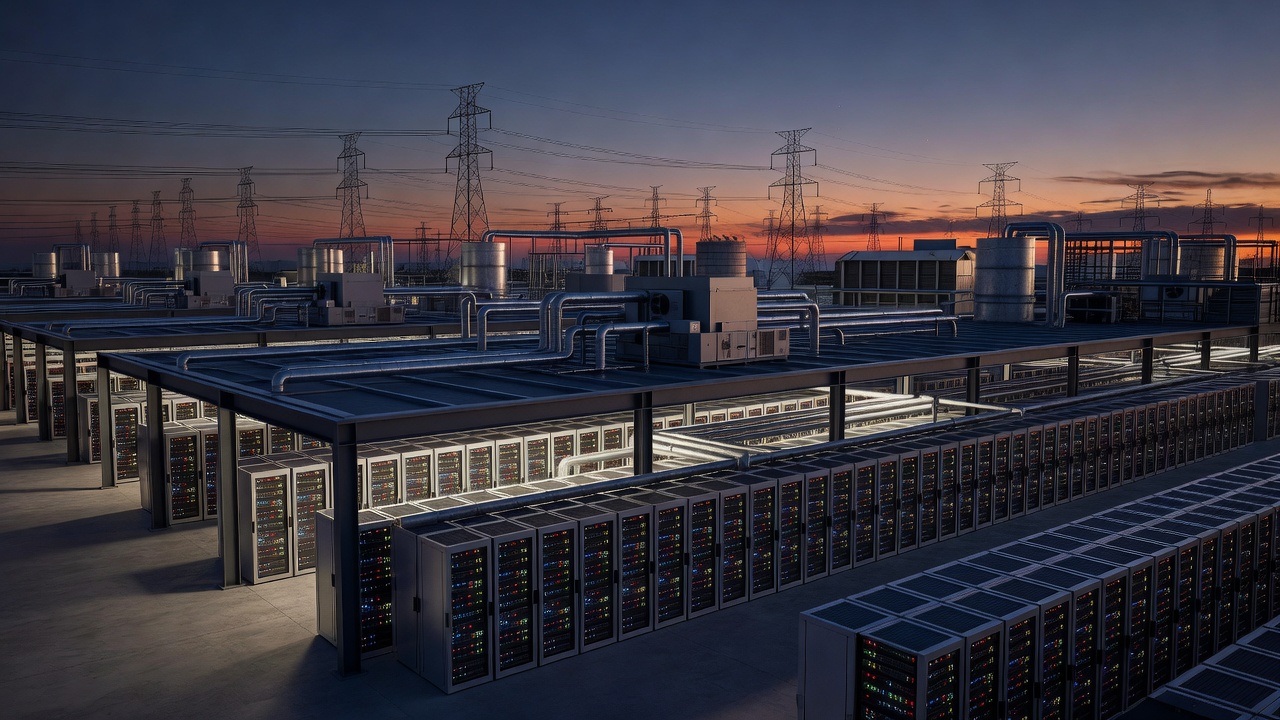
Big Tech is on pace to spend roughly $900 billion on AI infrastructure this year, double what it spent in 2024, and the industry still can’t agree on whether revenue is catching up or falling further behind. That disagreement — not any single model release — is now the central story in AI markets, and it’s one worth tracking quarter by quarter rather than treating as a one-off headline.
Why it matters: The AI capex vs revenue gap determines whether current valuations, debt loads, and power-grid commitments are rational bets on future demand or a bubble inflating on borrowed money. Builders shipping AI products sit downstream of this math — GPU pricing, cloud discounts, and infra availability all trace back to whether hyperscalers believe the spending is paying off.
The headline numbers, tracked
The Economist puts hyperscaler infrastructure spending at about $450 billion in 2024, rising to roughly $900 billion in 2025, and potentially $1.4 trillion by 2027. Goldman Sachs’ longer-range model is even larger: about $7.6 trillion in AI capital deployment between 2026 and 2031, starting near $765 billion in 2026 and climbing to $1.6 trillion by 2031. Consensus estimates for 2026 hyperscaler capex alone have already been revised up to $527 billion, per Goldman — a reminder that Wall Street has repeatedly underestimated how much these companies would actually spend.
| Metric | Figure | Source |
|---|---|---|
| 2024 hyperscaler infra spend | ~$450bn | The Economist |
| 2025 hyperscaler infra spend | ~$900bn | The Economist |
| Projected 2027 spend | ~$1.4tn | The Economist |
| 2026 consensus hyperscaler capex | $527bn | Goldman Sachs |
| 2026–2031 total AI capital | ~$7.6tn | Goldman Sachs |
| 2025 AI-related borrowing | $400bn+ | The Economist |
| Alphabet Q2 2025 capex | $44.9bn | Alphabet earnings |
| Alphabet FY2026 capex guidance | $195bn–$205bn | Alphabet earnings |
What’s changed: this isn’t just a GPU story anymore
Early AI capex debates centered on GPU shortages and Nvidia order backlogs. That framing is outdated. The current spending wave spans data centers, power generation, cooling systems, and grid interconnects — infrastructure with multi-year build times and long depreciation schedules. The Economist frames this as a historic investment surge; Goldman Sachs models it as a multi-trillion-dollar capital cycle running through 2031, not a short-term GPU rush.
Alphabet is a useful single-company case study. Its Q2 2025 capex hit $44.9 billion, and management raised full-year guidance to $195–$205 billion — an upward revision made mid-year, at mega-cap scale, which shows infrastructure budgets are still moving faster than plans made just months earlier.
The unresolved question: is revenue catching up?
Here the sources genuinely disagree, and that disagreement is the most important thing to track going forward. One line of reporting says the AI capex vs revenue gap is still widening — spending is outrunning what AI products actually generate. Another reading suggests revenue has recently pulled ahead on a depreciation basis, meaning the assets being built are starting to earn back their cost faster than they’re being written down. Both claims can’t be fully true at the same time across the industry, which suggests the answer varies significantly by company, workload, and accounting method — exactly the kind of nuance a one-time headline can’t capture.
Cloud GPU economics: the metric that matters more than model quality
Goldman Sachs notes that investors have already started rotating away from infrastructure-heavy names where operating earnings are under pressure and debt is subsidizing capex. That’s a market signal, not a technical one: it means GPU utilization rates, payback periods on data-center investment, and revenue generated per dollar of infrastructure are becoming the real leaderboards in this cycle — more consequential for near-term valuations than which model tops a benchmark.
For builders, this matters directly. If hyperscalers are financing capex partly through more than $400 billion in borrowing this year, per The Economist, then cloud GPU pricing, reserved-instance discounts, and compute availability are all downstream of how comfortable lenders and investors remain with that debt load. A slowdown in capex financing would likely show up first as tighter GPU supply or pricing changes before it shows up in any model release.
What to watch next
- Q3/Q4 hyperscaler earnings calls for further capex guidance revisions, especially from Alphabet, Microsoft, Amazon, and Meta
- Whether Goldman’s $527bn 2026 consensus figure gets revised up again, continuing the pattern of underestimation
- Depreciation schedules and whether any hyperscaler discloses AI-specific revenue-to-capex ratios
- Credit market appetite for further AI-related borrowing beyond the $400bn+ already deployed in 2025
This is a living story with new data points every earnings season — we’ll update this tracker as fresh capex and revenue figures land.